
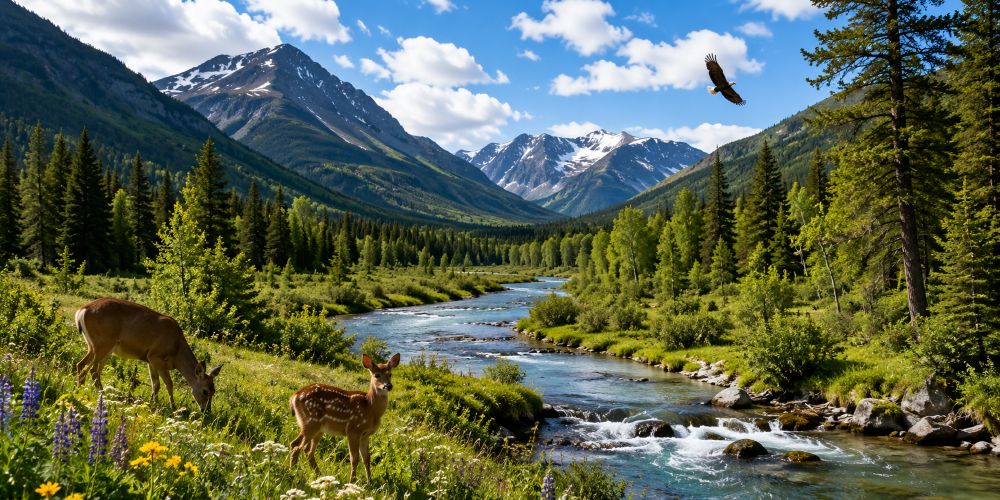
From recovering forests to returning wildlife and restored waterways, nature has an extraordinary ability to recover when given the chance.
Nature can be remarkably resilient. Around the world, landscapes once badly damaged by farming, conflict, development or environmental degradation are showing that recovery is possible.
Environmental stories often focus on what we’re losing. Those stories matter, but they’re not the whole picture.
When damaging pressures are reduced — and people give ecosystems protection, space and sometimes a helping hand — forests can return, wildlife populations can rebuild and damaged landscapes can become productive again.
Here are seven examples that give us reasons for hope.
1. Gorongosa National Park, Mozambique 🇲🇿
Few conservation stories are as dramatic as Gorongosa.
Mozambique’s civil war devastated wildlife populations in the park, with monitored large-mammal populations falling by more than 90%. But restoration, protection, wildlife reintroduction and community programs have helped produce a substantial recovery.
The comeback isn’t simply about bringing animals back. Restoration efforts have also focused on the communities surrounding the park, including employment, education and sustainable agriculture.
Gorongosa demonstrates something powerful:
Even an ecosystem pushed close to collapse can be given another chance.
2. The Loess Plateau, China 🇨🇳
Parts of China’s vast Loess Plateau once suffered from severe erosion and extensive land degradation.
Over several decades, restoration efforts supported by China and the World Bank combined vegetation recovery with terracing, water management and changes to land use.
The transformation has been extraordinary. The World Bank reports that close to four million hectares have been restored across the plateau over roughly four decades.
Land once regarded as severely depleted has become greener and more productive.
It’s an example of environmental restoration helping both landscapes and livelihoods.
3. Knepp, England 🇬🇧
Sometimes nature’s recovery begins by doing less.
At the Knepp Estate in southern England, land that had struggled under intensive agriculture began a radically different experiment around the beginning of this century.
Instead of trying to control every part of the landscape, the estate increasingly allowed natural processes to shape it.
Trees, scrub and wetlands regenerated, creating new habitats for wildlife. Knepp reports improvements including soil restoration, water storage and habitat for rare species and pollinating insects.
The project has become an influential example of rewilding — allowing nature much more freedom to rebuild functioning ecosystems.
4. Forest Landscapes in Costa Rica 🇨🇷
Costa Rica has become one of the world’s best-known examples of a country changing its relationship with forests.
After decades in which large areas of forest were cleared, conservation policies, protected areas, forest regeneration and incentives for landowners helped reverse the direction of travel.
The result is a country now widely associated not only with tropical biodiversity, but with the idea that forest decline does not have to be permanent.
It is an encouraging reminder that national policy and local conservation can work together over decades.
5. Wetlands Being Restored Across Europe 🇪🇺
Wetlands were once commonly drained or altered to make way for agriculture and development.
Today, restoration projects across Europe are reversing some of that damage.
Rivers are being reconnected with floodplains. Peatlands are being rewetted. Marshes are being restored.
These landscapes aren’t simply beautiful. Healthy wetlands can provide habitat, store water and help landscapes cope with flooding.
Perhaps most encouragingly, when water and natural processes are restored, wildlife can sometimes return surprisingly quickly.
6. Recovering Forests in South Korea 🇰🇷
South Korea experienced extensive forest degradation during the first half of the twentieth century and around the Korean War.
A major national reforestation effort followed.
Over subsequent decades, tree planting, forest protection and changes in land management helped transform many degraded hillsides.
The country’s experience has since become an important example of what sustained restoration efforts can accomplish at a national scale.
Forests don’t recover overnight.
But decades of commitment can completely change what a landscape looks like.
7. Rivers Returning to Life 🌊
Some of the most hopeful environmental transformations are happening along rivers.
Around the world, communities are removing obsolete barriers, restoring riverbanks, reconnecting floodplains and improving habitats.
And when rivers become healthier, life often follows.
Fish can regain access to spawning grounds. Wetland plants return. Birds find new feeding areas. Natural river systems can begin functioning again.
A river that has been heavily altered for generations doesn’t necessarily have to remain that way forever.
Nature Hasn’t Given Up
None of these stories means the world’s environmental problems are solved.
Restoration takes time. Some ecosystems cannot simply be recreated once they are destroyed, and protecting healthy natural areas remains enormously important.
But these recoveries challenge one particularly damaging idea:
That environmental decline is always irreversible.
Sometimes it isn’t.
A barren hillside can become green again.
Wildlife can return.
A wetland can refill.
A forest can regenerate.
A river can recover.
And when people decide that a damaged place is worth restoring, extraordinary things can happen.
The planet faces serious challenges.
But alongside the stories about what we’re losing, there are also places quietly showing us what we can get back.