
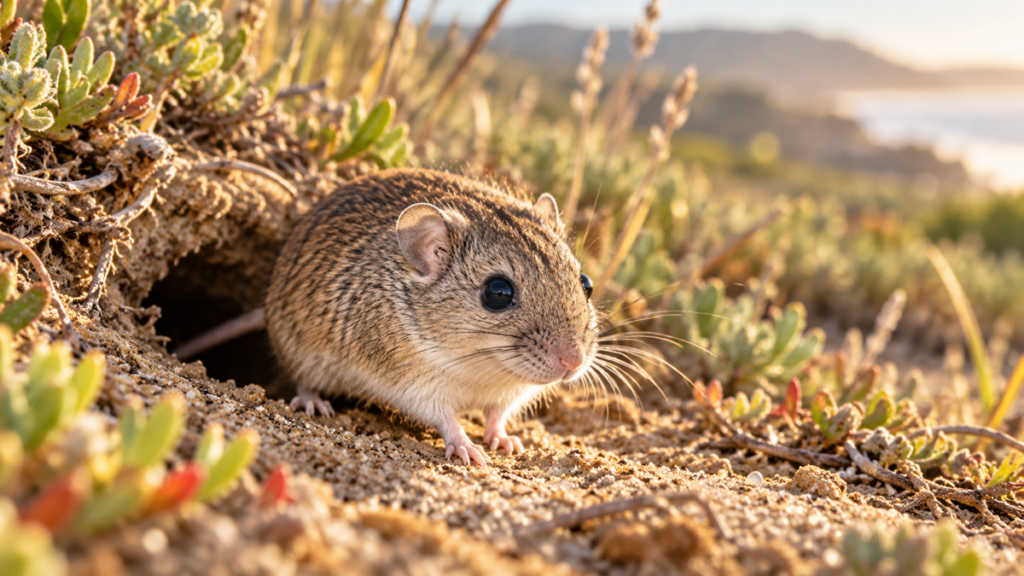
Pacific Pocket Mouse – It weighs only a few grams and can fit comfortably in a human hand.
For years, scientists feared it had disappeared altogether.
Now the Pacific pocket mouse, one of North America’s smallest and most endangered mammals, has reached another encouraging milestone: conservationists have established a third reintroduced population in the wild.
The new population has been established at North San Mateo on Marine Corps Base Camp Pendleton in Southern California, the San Diego Zoo Wildlife Alliance announced on October 6, 2026.
For a species that once went about two decades without a confirmed sighting, that is meaningful progress.
From “Possibly Gone” to a Long-Term Recovery Effort
The Pacific pocket mouse historically lived in coastal areas of Southern California, from Los Angeles County toward the Mexican border.
As coastal habitat was lost and fragmented, its numbers collapsed.
For about 20 years, there were no reports confirming that the animal still survived. Then, in 1993, a population was rediscovered at Dana Point Headlands in Orange County. The U.S. Fish and Wildlife Service federally listed the subspecies as endangered in 1994, and additional populations were later found at Camp Pendleton.
Rediscovery, however, did not mean the species was safe.
Its remaining populations were small and vulnerable, while habitat fragmentation, invasive vegetation, disturbance and other pressures continued to threaten its survival.
That began a long conservation effort that is still continuing today.
More Than 500 Mice Released
The San Diego Zoo Wildlife Alliance launched its Pacific Pocket Mouse Conservation Program in 2006.
A conservation breeding effort followed in 2012, designed not simply to produce more animals but to maintain genetic diversity and prepare mice with the behaviours they would need to survive after release.
Since the programme began, more than 500 Pacific pocket mice have been released into new and existing populations within their native range, according to the Alliance.
The first reintroduced population was established at Laguna Coast Wilderness Park in 2016.
A second followed at Camp Pendleton in 2024.
Now North San Mateo has become the location of the third.
That progression matters because species recovery is safer when animals are not dependent on just one or two fragile populations.
Signs That Reintroduction Can Work
There has already been encouraging evidence from earlier releases.
At the Camp Pendleton site established in 2024, conservationists released 90 Pacific pocket mice.
Monitoring later showed high short-term survival, and many of the animals reproduced. Researchers documented 100 wild-born offspring there — an important sign that released animals were not merely surviving temporarily but beginning to establish a functioning population.
The newly announced North San Mateo population is another step in that longer recovery process.
It is important not to overstate what has happened: the Pacific pocket mouse is still endangered, and the new population does not mean the species has recovered.
But it does mean conservationists have created another foothold in its historic range.
Small Animal, Bigger Ecological Role
The Pacific pocket mouse may be tiny, but its ecological role is not.
These nocturnal animals dig burrows in sandy coastal soils. That burrowing can influence soil structure and the small-scale ecology around them, while the species is itself part of the food web of Southern California’s coastal habitats.
Restoring the mouse therefore means restoring more than a number on a population chart. It means returning a native species to places where it once belonged.
Recovery Takes Partnerships — and Time
The project also shows how wildlife recovery often depends on organisations working together over many years.
The Pacific pocket mouse effort includes the San Diego Zoo Wildlife Alliance, the U.S. Fish and Wildlife Service, California Department of Fish and Wildlife, U.S. Geological Survey and Marine Corps Base Camp Pendleton.
Camp Pendleton is an active military training installation, but it also contains significant habitat for threatened and endangered wildlife. Its natural-resources planning includes habitat management intended to support Pacific pocket mouse recovery.
The establishment of another population on that landscape shows what long-term coordination can make possible.
The Quiet Kind of Good News
Wildlife recovery rarely happens in one dramatic moment.
It is usually made of smaller steps: protecting habitat, studying genetics, breeding animals, releasing them, monitoring what happens, learning from setbacks and trying again.
For the Pacific pocket mouse, that process has now stretched across decades.
The species remains vulnerable. Its future is not guaranteed.
But an animal once feared lost now has three populations created through reintroduction, alongside surviving natural populations.
That is not the end of the recovery story.
It is evidence that the story is still being written.
NewsPositive Takeaway
Sometimes conservation success is not a species suddenly becoming abundant again.
Sometimes it is a few grams of life returning to a place where it had disappeared.
Twenty years of careful work have now given the Pacific pocket mouse another wild population — and another chance.
Good things are happening. We’re here to find them.
Sources
- San Diego Zoo Wildlife Alliance — October 6, 2026 announcement
- U.S. Fish & Wildlife Service — Pacific pocket mouse species profile
- San Diego Zoo Wildlife Alliance — reintroduction progress and 2024 release results
- Marine Corps Base Camp Pendleton — Integrated Natural Resources Management Plan
Editorial note: The establishment of the third reintroduced population is confirmed. The Pacific pocket mouse remains federally endangered, and long-term success of the newest population will depend on continued monitoring and habitat management.