Discover 8 technologies already improving lives, from renewable energy and medical AI to early-warning systems, accessible technology and wildlife tracking.
When people imagine technology changing the world, they often picture something dramatic: humanoid robots, flying cars or a revolutionary invention appearing overnight.
But some of the technologies making the biggest difference aren’t particularly flashy.
They’re helping doctors detect disease. They’re giving communities earlier warnings before disasters. They’re helping farmers use water more efficiently, making renewable electricity more practical, improving independence for people with disabilities and even helping scientists follow animals from space.
The progress isn’t perfect. Access remains unequal, technologies can create new risks, and innovation alone cannot solve social or environmental problems.
But behind the headlines, some remarkable tools are already helping people solve real problems.
Here are eight worth knowing about.
1. Solar Power Is Becoming a Major Part of the World’s Electricity System
Solar energy has moved far beyond being an experimental alternative.
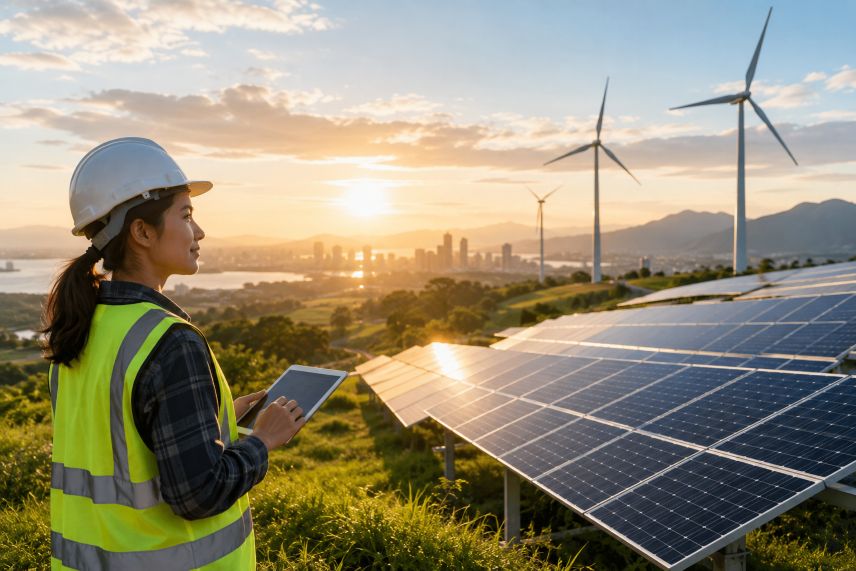
According to the International Energy Agency, global renewable-energy capacity additions reached a record 800 gigawatts in 2025, with solar accounting for about three-quarters of those additions. The increase in solar generation alone supplied around 70% of global electricity-generation growth that year.
That’s significant because electricity demand continues to grow.
Every additional unit that can be supplied by low-emissions generation rather than fossil fuels changes the equation.
Solar technology isn’t a complete answer to climate change. Electricity grids still need transmission, storage, flexibility and other sources of generation.
But what was once considered an expensive niche technology has become one of the world’s fastest-growing sources of electricity.
That’s real progress.
2. Batteries Are Helping Renewable Energy Work When the Sun Isn’t Shining
Solar panels have an obvious limitation.
The sun goes down.
Wind turbines have one too.
The wind doesn’t always blow.
That’s why improvements in energy storage matter so much.
Battery-storage capacity additions grew by around 40% in 2025, reaching almost 110 GW and making battery storage the world’s fastest-growing power technology that year, according to the IEA.
Batteries can store electricity when production is plentiful and release it later when the grid needs it.
They can also help electricity systems respond more quickly to changing supply and demand.
Storage isn’t magic: batteries require materials, infrastructure and responsible supply chains, and different electricity systems need different combinations of technologies.
But better storage makes it easier to integrate larger amounts of variable renewable energy.
Sometimes the technology changing the world isn’t the thing generating the power.
It’s the thing helping us save it for later.
3. AI Is Already Helping Doctors Detect Disease
Artificial intelligence in medicine is often discussed as though it belongs to the future.
Parts of that future have already arrived.
In April 2026, WHO reported that 74% of EU countries were using AI-assisted diagnostics, including systems supporting medical imaging, disease detection and clinical decision-making.
The promise isn’t that AI replaces doctors.
The more useful vision is that technology helps health professionals analyze information, recognize patterns and make better-informed decisions.
There is an important warning attached.
WHO has also highlighted a substantial gap between adoption and governance. Across the broader WHO European Region, nearly two-thirds of countries were deploying AI in diagnostics by July 2026, while only 8% had a health-specific AI strategy.
So this is both an encouraging story and a reminder.
Powerful technology needs powerful safeguards.
Patient privacy, bias, accountability, clinical validation and human oversight matter.
Used responsibly, however, AI may become an increasingly valuable tool in the doctor’s toolkit.
4. Technology Is Helping Farmers Grow More With Less
A modern farm can now combine information from satellites, sensors, smartphones, weather services, GPS systems, drones and artificial intelligence.
The goal isn’t technology for technology’s sake.
It’s better decisions.
Precision agriculture can help farmers determine where water is needed, where crops are under stress, how much fertilizer to apply and when intervention is actually necessary.
FAO says smart-farming technologies can optimize the use of water, fertilizers, pesticides and energy while improving productivity and resilience.
That’s particularly important in a world where agriculture faces pressure from climate change, water scarcity and the need to feed a growing population.
There are still obstacles. Technology can be expensive, rural connectivity remains inadequate in many places, and smaller farmers may lack training or infrastructure.
But precision agriculture illustrates a broader idea:
Sometimes progress doesn’t mean producing endlessly more.
It means wasting less of what we already have.
5. Better Water Technology Can Help Communities Choose the Right Solution
Providing safe drinking water isn’t simply a matter of inventing one miraculous filter.
Water sources, contamination, infrastructure and community needs vary enormously.
Technology therefore ranges from treatment and disinfection systems to pumps, distribution infrastructure and household-level solutions.
In 2025, WHO published a comprehensive reference covering drinking-water technologies from source through treatment and distribution to household use, designed to help planners choose solutions appropriate to local conditions, resources and water-quality challenges.
That last part matters.
The best technology isn’t necessarily the newest or most expensive.
It’s the one that works reliably where people actually need it.
Innovation in clean water is increasingly about combining engineering with local knowledge, maintenance, monitoring and good public-health systems.
And few technologies have a more fundamental purpose than helping make something as basic as a glass of water safer.
6. Assistive Technology Is Giving More People Independence
Some of the world’s most life-changing technology can appear surprisingly ordinary.
A hearing aid.
A wheelchair.
A prosthetic limb.
Speech-recognition software.
Captioning.
A white cane.
Communication software.
These technologies can change whether someone can study, work, communicate, move independently or participate fully in everyday life.
WHO estimates that more than 2.5 billion people currently need one or more assistive products, a figure expected to rise beyond 3.5 billion by 2050.
Unfortunately, access remains deeply unequal—in some settings, WHO says access can be as low as 3%.
So this isn’t simply a technology success story yet.
It’s an opportunity.
Innovation becomes genuinely transformative when the people who need it can actually access it.
7. Early-Warning Systems Are Giving People More Time Before Disaster Strikes
Sometimes technology’s greatest gift is time.
Time to evacuate.
Time to move livestock.
Time to secure a home.
Time to get boats ashore.
Time to prepare hospitals and emergency services.
Weather satellites, forecasting models, telecommunications networks and alert systems increasingly work together to provide earlier warnings of dangerous events.
In 2025, the World Meteorological Organization and UN Office for Disaster Risk Reduction reported that 119 countries—60% of all countries—had multi-hazard early-warning systems, more than double the number a decade earlier.
The comprehensiveness of those systems had also improved by an average of 45% since 2015.
Large gaps remain, particularly in vulnerable countries and small island developing states.
But the direction matters.
We cannot stop every storm, flood or heat wave.
Technology can sometimes help us know what’s coming sooner.
And minutes or hours of warning can matter enormously.
8. We’re Learning to Watch Wildlife From Space
One of the most fascinating conservation technologies isn’t happening in a forest.
It’s happening hundreds of kilometres above it.
Satellites and increasingly sophisticated tracking systems allow scientists to observe habitats, monitor environmental change and understand how animals move across enormous distances.
NASA’s Internet of Animals project combines animal-tracking information with Earth-observation data to improve biodiversity research and conservation. The technology can help researchers understand migration routes, protected areas, disease movement and human-wildlife conflicts.
NASA-supported researchers are already combining GPS tracking of golden eagles with satellite observations to identify migration routes, wintering grounds and hazards across vast landscapes.
Satellites are also being used to monitor habitats for animals including tigers, jaguars and elephants.
We can’t protect what we don’t understand.
Technology is giving conservationists a much bigger window onto the living planet.
Progress Doesn’t Always Arrive With a Drumroll
None of these technologies will fix the world by itself.
AI can create risks as well as benefits.
Renewable energy requires infrastructure.
Batteries require materials.
Digital agriculture isn’t accessible to every farmer.
Billions of people still lack assistive technology they need.
Early-warning coverage remains incomplete.
And technology cannot substitute for good institutions, thoughtful policy or human judgment.
But that’s precisely why these stories matter.
Progress doesn’t mean everything is solved.
It means something that was difficult yesterday is becoming more possible today.
A doctor sees something earlier.
A farmer wastes less water.
A person communicates more easily.
A community receives a warning sooner.
A conservationist discovers where an endangered animal travels.
A battery saves today’s sunshine for tonight.
None of these developments needs to look like science fiction.
They’re already happening.
And quietly, piece by piece, they’re giving us better tools to build tomorrow.
NewsPositive.org – News That Inspires. Stories That Heal.