
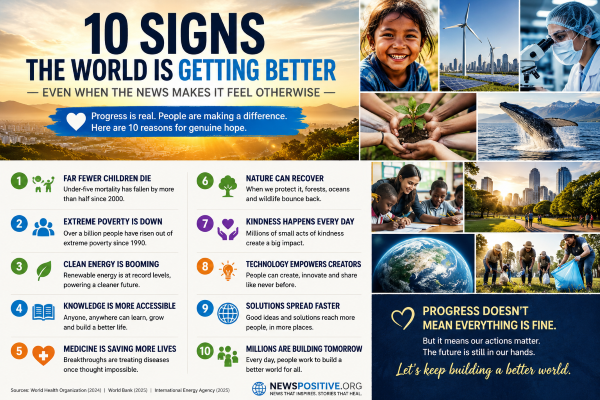


10 signs: open the news each morning and you may think the world is falling apart.
Wars, Political division, Climate disasters, Economic uncertainty, Crime. Conflict.
Bad news demands our attention.
There is another story unfolding at the same time.
It is quieter.
It rarely generates alarming notifications on your phone. It doesn’t always dominate television broadcasts or social media feeds.
Millions of people around the world are solving problems.
They save lives, develop cleaner technologies, protect nature, and improve their communities.
These are 10 signs of global progress.
The world has serious problems. We should never pretend otherwise.
But progress is real too.
Here are 10 reasons to remember that.
1. Far Fewer Children Die Before Their Fifth Birthday
This may be one of humanity’s most important achievements and yet it rarely becomes headline news.
According to the World Health Organization, the global mortality rate for children under five fell to 37.4 deaths per 1,000 live births in 2024 — less than half the rate in 2000.
Millions of families have benefited from improvements in sanitation, nutrition, maternal care, antibiotics and access to basic healthcare.
There is still an enormous amount of work to do. Millions of young children continue to die each year, often from preventable or treatable causes and progress has slowed in recent years.
But compared with only a generation ago, a child born today has a substantially better chance of surviving early childhood.
That is progress worth recognizing.
2. Extreme Poverty Has Fallen Dramatically Over the Long Term
Poverty remains one of humanity’s greatest challenges.
The long-term picture is very different from what many people imagine.
World Bank data show that around 2.3 billion people lived in extreme poverty in 1990.
By 2025, that figure was around 831 million.
That means well over a billion people have moved beyond extreme poverty over the past few decades.
The progress is far from complete. Poverty reduction has slowed substantially and conflict, debt, economic shocks and instability threaten further gains.
The historical transformation is extraordinary.
Humanity has demonstrated that extreme poverty is not an unchangeable condition.
3. Clean Energy Is Breaking Records
Something remarkable is happening to the way the world produces electricity.
In 2025, approximately 800 gigawatts of renewable power capacity were added worldwide, according to the International Energy Agency.
It was another record.
In fact, 2025 marked the 23rd consecutive year in which renewable-energy expansion set a new record.
Solar power accounted for more than three-quarters of the new renewable capacity.
renewable supplied about 34% of global electricity generation in 2025, compared with roughly 23% a decade earlier.
The energy transition isn’t finished — not remotely.
But it is no longer simply an environmental ambition for the distant future.
It is happening now.
4. Human Knowledge Has Never Been More Accessible
For most of human history, access to knowledge depended enormously on where you were born and what resources your family possessed.
Books could be expensive.
Universities were inaccessible to most people.
Experts might live hundreds or thousands of kilometers away.
Today, someone with an internet connection can learn mathematics, languages, programming, science, history, entrepreneurship and thousands of other subjects from teachers scattered across the planet.
A teenager in a small village can watch a university lecture.
An entrepreneur can learn how to build a website.
Someone changing careers can acquire entirely new skills from their kitchen table.
Access remains deeply unequal, and misinformation presents a serious challenge.
Humanity has never possessed such an extraordinary infrastructure for sharing knowledge.
5. Medicine Is Solving Problems That Once Seemed Impossible
Think about what medicine has accomplished within just a few generations.
Diseases that once routinely killed millions can now be prevented.
Surgeons can replace damaged organs.
Scientists can sequence genomes.
Doctors can use increasingly sophisticated imaging to see inside the human body without surgery.
Researchers are developing personalized treatments based on genetics and using new technologies to detect diseases earlier.
Not every breakthrough succeeds.
Not every treatment reaches everyone who needs it.
Every day, scientists, doctors, nurses, engineers and researchers are working on problems that previous generations could barely imagine solving.
6. Nature Can Recover When We Give It the Chance
Environmental destruction is real.
As well as environmental recovery.
Forests can regenerate.
Wetlands can be restored.
Rivers can become cleaner.
Wildlife populations can rebound.
Damaged habitats can return when communities, conservationists, scientists and governments work together.
This matters because environmental problems can sometimes feel irreversible.
They aren’t always.
Nature can be remarkably resilient.
The lesson isn’t that we can stop worrying about the environment.
It’s that our actions can make a measurable difference.
7. Millions of Ordinary People Help Strangers Every Day
These stories rarely become international headlines.
A neighbor checks on an elderly person living alone.
Someone donates blood.
A teacher stays late to help a struggling student.
A volunteer delivers food.
A stranger returns a lost wallet.
A community raises money for a family facing disaster.
None of these actions will change the world by themselves.
Together, they are part of what keeps the world functioning.
Human kindness is difficult to measure precisely because much of it happens quietly.
Quiet doesn’t mean insignificant.
8. Technology Is Giving More People the Ability to Create
Not long ago, publishing a book required a publisher.
Broadcasting video required a television station.
Selling products internationally required significant capital.
Building software required expensive infrastructure.
Today, individuals can create businesses, publish their ideas, teach audiences, produce films, design products and collaborate with people on the other side of the planet using tools that previous generations never possessed.
Technology brings new risks and difficult questions.
It has also placed extraordinary creative power into the hands of ordinary people.
The next world-changing idea doesn’t necessarily have to begin inside a giant corporation.
It might begin at someone’s kitchen table.
9. Humanity Is Better at Sharing Solutions
When researchers discover something important, knowledge can travel around the world almost instantly.
When one city develops an effective transport system, other cities can study it.
When doctors improve a medical procedure, practitioners elsewhere can learn from it.
When farmers develop better techniques, those ideas can spread.
When communities discover successful conservation strategies, others can adapt them.
Problems can spread quickly in an interconnected world.
Solutions can spread quickly too.
That may prove to be one of humanity’s greatest advantages.
10. There Are Millions of People Working on Tomorrow
Perhaps the strongest reason for hope isn’t a statistic.
It’s people.
Right now, somewhere in the world, someone is researching a disease.
Someone is planting a tree.
Someone is teaching a child.
Someone is designing cleaner technology.
Someone is rescuing an animal.
Someone is starting a company.
Someone is rebuilding after disaster.
Someone is helping a stranger.
Someone is trying again after failing yesterday.
We tend to notice the people destroying things because destruction makes news.
But every day, an enormous number of people wake up and quietly try to build something better.
They deserve our attention too.
Progress Doesn’t Mean Everything Is Fine
Optimism should never require us to ignore suffering.
War is real.
Poverty is real.
Climate change is real.
Inequality, disease, loneliness and injustice are real.
Positive news should not hide those realities.
It should remind us of something equally important:
Problems are not the only things happening in the world.
Progress is happening too.
Recognizing progress isn’t naive.
It can remind us that human action matters.
Yesterday’s impossible problem can become tomorrow’s solved problem.
A damaged ecosystem can recover.
A disease can become treatable.
A struggling community can rebuild.
A frightened child can grow up to create something extraordinary.
Perhaps the world isn’t simply getting better or getting worse.
Perhaps billions of people are constantly deciding which direction it moves.
And that means there is still plenty worth working for.
NewsPositive
News That Inspires. Stories That Heal.
If this article gave you a little more hope about the world, share it with someone who could use some good news today.