
After 200 Years, Wildlife Is Returning to Places It Once Disappeared From
Wildlife comeback stories are giving conservationists hope. Discover how eagles, choughs and ostriches are returning to places they disappeared from decades ago.
For generations, some landscapes have been missing something.
A bird that once circled overhead. A familiar call from the cliffs. An animal that belonged to a place long before anyone alive today could remember seeing it there.
When a species disappears, its absence can begin to feel permanent but sometimes, it isn’t.
Across different parts of the world, conservationists, local communities, scientists, landowners and volunteers are working to bring lost wildlife home. And in 2026, several of those long-term efforts reached remarkable milestones.
These aren’t stories of nature magically repairing itself overnight. They are stories of what can happen when people spend years — sometimes decades — rebuilding the conditions wildlife needs to return.
Giant Eagles Are Flying Over England Again
Look toward the skies of southern England and you might now see something that would have been almost unimaginable a few decades ago.
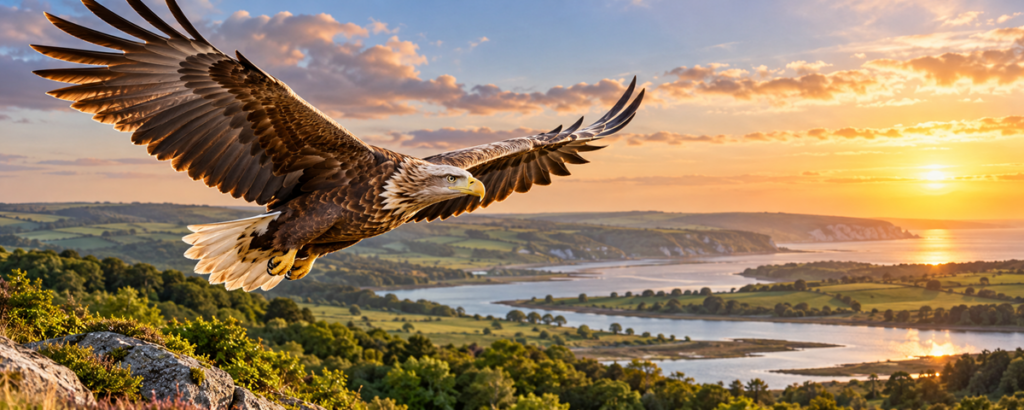
A white-tailed eagle
With a wingspan reaching around 2.5 meters, the white-tailed eagle is Britain’s largest bird of prey. The species was once widespread across England, but persecution eventually wiped it out; the last pair known to breed in southern England did so in 1780.
More than two centuries later, that story is changing.
In 2019, Forestry England and the Roy Dennis Wildlife Foundation began releasing young white-tailed eagles on the Isle of Wight as part of a long-term reintroduction program. The first wild-born chick from the project fledged in 2023, the first in southern England for more than 240 years and this summer brought another encouraging sign.
Three more wild-born eagle chicks successfully fledged in England in 2026 — one in Dorset and two in Sussex.
That means nine white-tailed eagles have now been born in the wild through the project. Five released pairs have also formed established bonds, suggesting the returning population is beginning to put down roots.
The restoration effort is expanding, too. Six young white-tailed eagles were released in Exmoor National Park in August 2026, with the aim of helping the population extend into southwest England.
This is no longer simply a story about releasing birds.
It is increasingly a story about birds raising the next generation themselves.
A Bird Missing From Kent for Two Centuries Is Raising Chicks Again
Another comeback is unfolding along the chalk grasslands and cliffs of Kent.
The red-billed chough is an unmistakable member of the crow family, with glossy black feathers and a bright red bill and legs.
It was once part of Kent’s natural landscape.
Then it disappeared.
Habitat loss, changing agricultural practices and historical persecution contributed to the chough’s extinction in the county more than 200 years ago. Yet its cultural memory survived — the bird can still be found on signs and heraldry around Kent.
Conservationists decided to try to bring the real birds back.
A reintroduction project launched in 2019, following decades of work to restore the chalk grasslands the birds depend upon.
Captive-reared choughs were released beginning in 2023.
Then came the milestone conservationists had been waiting for: in 2025, a chick successfully fledged from a wild nest in Dover.
In 2026, things accelerated.
Eight wild-born chough chicks fledged in Kent this summer.
There are now nine wild-born birds contributing to a Kent population of 35 choughs, according to Kent Wildlife Trust. The birds have also begun appearing farther from their initial Dover stronghold, including around Thanet and Folkestone.
What makes the story especially interesting is what happened before the birds returned.
For roughly four decades, conservation groups and partners had been restoring Kent’s chalk grasslands and bringing conservation grazing back to parts of the landscape.
The birds’ comeback therefore isn’t just about the birds.
Restore the habitat, and you create the possibility for wildlife to return.
In Niger, Ostriches Are Walking Free Again
Thousands of kilometres away, another long-awaited return took place this September.
The North African ostrich — also known as the red-necked ostrich — once ranged widely across the Sahara and Sahel.
Hunting, egg collection and habitat degradation contributed to a dramatic decline. Niger’s last wild ostrich disappeared in 2004.
But conservationists didn’t give up on the species.
A captive-breeding program maintained genetically verified birds at several sites in Niger, while conservation organizations, authorities, protected-area managers and local communities worked toward an eventual return to the wild.
On September 2, 2026, that moment arrived.
Five female and three male North African ostriches were released into the Gadabedji Biosphere Reserve.
Eight birds taking a few steps into an open landscape might sound modest.
In conservation terms, it was enormous.
The reserve had not seen the species living wild there since 1955, according to Sahara Conservation. The eight birds now form a founder group that conservation teams will monitor for survival, movement, adaptation and, eventually, reproduction.
And there is another important part of the story.
People living around the reserve are part of the effort.
Before the release, an awareness campaign reached nearly 260 people across nine villages, discussing the ostrich’s ecological role, the reintroduction and how people and wildlife can coexist.
Because returning an animal to the wild is only the beginning.
The real goal is for it to stay.
Bringing Wildlife Back Takes Time
These three stories happened in very different environments.
Sea eagles over southern England.
Choughs on Kent’s grasslands.
Ostriches in the Sahel.
But they share something important.
None happened quickly.
The chough’s return depended on decades of habitat restoration.
The white-tailed eagle project began releasing birds in southern England in 2019, and the work continues today.
The North African ostrich release followed years of breeding, genetic management, habitat planning, conservation work and cooperation between organizations and communities.
Successful conservation can be slow.
There may be years when progress is difficult to see.
Then one summer, a chick leaves a nest.
A bird appears somewhere it hasn’t been seen for generations.
A gate opens, and an animal walks back into a landscape from which its species had disappeared.
A Comeback Isn’t the End of the Story
There is an important reason not to describe these successes as problems solved.
A handful of successful nests doesn’t mean a species is permanently secure.
Eight released ostriches don’t yet constitute a self-sustaining wild population.
Reintroduced animals still face threats ranging from habitat degradation and human disturbance to disease, climate pressures and insufficient genetic diversity.
That’s why conservationists continue monitoring these populations long after the excitement of the initial release has passed.
For the North African ostriches in Niger, for example, conservation teams explicitly say the real test will be whether the birds survive, adapt and eventually reproduce enough to establish a viable population.
That distinction matters.
Positive news becomes more credible when we don’t turn progress into perfection.
What These Returns Show Us
The global biodiversity crisis remains serious.
But that isn’t the only story happening in nature.
There are also landscapes being restored.
Species being protected.
Communities becoming involved.
Animals breeding again where they had disappeared.
And conservation programs learning what works.
Perhaps the most encouraging lesson isn’t simply that wildlife can return.
It’s that people can help create the conditions that make a return possible.
A species disappearing from a landscape can feel final.
These stories remind us that sometimes it isn’t.
Sometimes, after decades or even centuries, the wings return to the sky, the calls return to the cliffs, and the footprints return to the land.